How Conditional Student Entrepreneurship Shapes Employability and Career Paths
There is a widespread belief that obtaining a higher education degree enables graduates to secure better jobs and lift their families out of poverty. This belief has strongly motivated many families, particularly those from low-income backgrounds, to prioritise university education for their children despite rising tuition costs and limited household incomes. However, once their children gain admission into university, many families soon confront the harsh reality that the financial demands of higher education may be unsustainable. In some cases, this financial strain forces students to drop out, shattering the very hopes of graduation, employment, and upward mobility that initially justified the sacrifice.
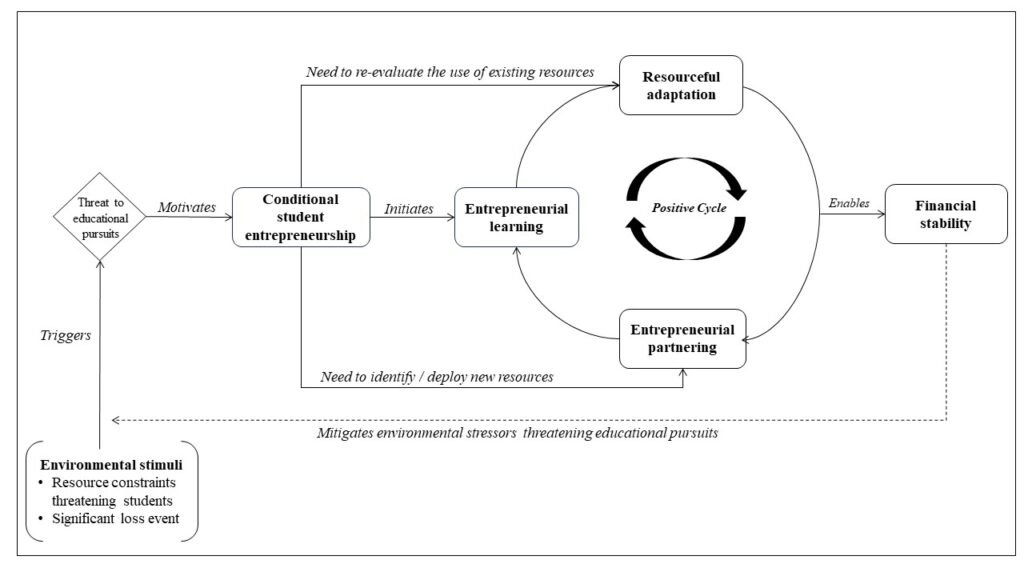
As a lecturer in a Nigerian public university, I witnessed many students drop out because their parents could no longer afford to fund their education. Scholarships are not easily accessible, and where they are available, only a few academically outstanding or politically connected students can access them. As a result, resilient students often join their peers to start micro-businesses from scratch with limited or no knowledge of running a business, to support themselves with tuition and other living expenses. They engage in these micro-businesses while studying because of the lack of part-time job opportunities on university campuses. I described this phenomenon as conditional student entrepreneurship, and I referred to the students involved as conditional student entrepreneurs. I observed that this form of entrepreneurship enables such students either to pursue entrepreneurship as a future career path or to develop essential employability skills that increase their chances of securing paid employment after graduation.
In this blog post, I discuss the types of micro-businesses that conditional student entrepreneurs engage in and highlight five ways in which conditional student entrepreneurship creates opportunities for student entrepreneurs to develop essential skills for their future career paths.
Types of Micro-Businesses that Conditional Student Entrepreneurs Engage In
Conditional student entrepreneurs operate their micro-businesses on campuses and around their universities’ host communities. They engage in selling goods, providing paid services or digital trades to support their daily needs, pay for accommodation rents, buy study materials and also pay their tuition fees. They engage in the following categories of micro-businesses:
Retail trading: Selling cooked and baked foods and pastries, drinks, laptop accessories, mobile phone gadgets, school bags, stationery, or second-hand clothes or footwear.
Service-based businesses: Running barbing, hair weaving and dressing, tailoring, small laundry or home cleaning services, tutoring for fellow students.
Digital hustles: Engaging in graphic design, freelance writing, online marketing, or managing small e-commerce shops on free WordPress websites. They leverage platforms like Instagram, Facebook and WhatsApp for marketing.
Campus-based opportunities: Acting as middlemen for hostel rentals, photocopy and printing services, or organising social events like birthday parties for students.
In Nigeria, public universities and other higher education institutions are typically established in a single permanent location. This means that all faculties and departments are concentrated within one location and often situated in less developed host communities. Such settings create opportunities for conditional student entrepreneurs to access a concentrated market composed of a large student population, university staff, visitors and residents of the host communities.
Five Ways Conditional Student Entrepreneurship Creates Opportunities for Developing Employability Skills
During my research at ACCESS at Leipzig University, I developed five ways. But this list is not exhaustive. They included:
Problem-solving and Creativity: Juggling the dual role as both micro-business owners and students compels conditional student entrepreneurs to think critically and find innovative solutions within their limited resources. Their ability to manage their business activities alongside study demands nurtures their creativity and practical problem-solving skills. These are essential skills or qualities that employers highly value in graduates. Also, these skills can be leveraged to expand their micro-businesses into bigger ventures after graduation. This can also pave way for them to pursue entrepreneurship as a future career path.
Resourceful Adaptation: Conditional student entrepreneurs often start their micro-businesses without formal start-up capital, mentorship, or prior entrepreneurial experience. They are simply pushed into entrepreneurial activities due to their financial need to continue their education. Many operate from their hostel rooms and leverage social media platforms to market their products and services. Managing and sustaining micro-businesses with limited resources teaches them how to maximize whatever resources that available for their businesses. It compels them to be flexible and strategic in managing limited available resources to achieve their goals. This is a crucial quality that employers highly value in graduates.
Communication and Interpersonal Skills: As conditional student entrepreneurs operate their micro-businesses, they interact with customers, suppliers and peers. Through these interactions, they gradually develop clear communication, negotiation and teamwork skills. They learn to listen to customers’ complaints and feedback, resolve conflicts and learn to build trust-based relationships that can sustain their micro-businesses. These skills can enable them to grow their businesses into bigger firms or obtain jobs in business firms after their graduation.
Financial and Business Management Skills: As conditional student entrepreneurs engage in micro-business activities while schooling, they learn to budget, keep records of their income and expenditures, and plan their finances well. These can help them to develop financial literacy and managerial skills, which they essential for sustaining their micro-businesses or succeeding in paid employment after graduation.
Time Management and Self-Discipline: Because conditional student entrepreneurs balance their micro-business activities with academic responsibilities, they must prioritize their tasks and plan their schedules carefully to enable them meet deadlines. Their ability to constantly juggle both roles as students and micro-business owners can foster their development of organisational skills, self-discipline and ability to work under pressure. They can also learn to allocate time effectively, handle competing demands and maintain productivity. Mastering these essential skills prepares them for future challenges in both their entrepreneurial ventures and formal employment.
Call for Research Action
Student entrepreneurship is no longer a peripheral activity within universities in emerging economies. It has become a critical pathway through which many students navigate financial constraints, develop employability skills, and prepare for life after graduation. Yet, empirical research that captures what students actually do entrepreneurially during their university years and how these experiences shape their transition into the labour market remains limited.
To address this gap, I am currently leading a Special Issue titled “Career Development and Student Entrepreneurship for University-to-Work Transition in Emerging Economies.” This Special Issue invites rigorous empirical studies using qualitative, quantitative, or mixed-methods approaches that examine how student entrepreneurship during university education influences career development, employability skills acquisition, and readiness for entry into the world of work. Importantly, the focus is on entrepreneurial experiences rather than intentions, particularly within resource-constrained and institutionally complex contexts.
Researchers, doctoral students, and practitioners are encouraged to contribute studies that foreground lived entrepreneurial practices, contextual realities, and policy-relevant insights from emerging economies. By advancing evidence-based understanding in this area, we can better inform university policies, career development strategies, and support systems that reflect students’ real economic and institutional conditions.
This is a timely opportunity to collectively rethink how student entrepreneurship is theorised, measured, and supported as a bridge between university education and sustainable career pathways. To contribute to the SI call for papers, please visit https://www.emeraldgrouppublishing.com/calls-for-papers/career-development-and-student-entrepreneurship-university-work-transition.
Opening date for manuscript submissions: 1st November 2025
Closing date for manuscript submission: 1st October 2026